i was watching clips from tarzan (1999) on youtube the other night. one scene - where he's getting on the ship and takes a last look back at the jungle - the jungle, the music and then back to him - is something really special. and in fact it's something specific, something that shows up across a wide range of things at particular moments, no doubt different moments for different people and some in common. C.S. Lewis in Mere Christianity talks about the idea of "Bios" vs. "Zoe" - physical, biological life vs. spiritual, divine life, where the former is only a symbol and shadow the latter, as other attributes of the physical world are only shadows of the "true" version of them in the spiritual and divine realm:
Everything God has made has some likeness to Himself. Space is like Him in its hugeness: not that the greatness of space is the same kind of greatness as God's, but it is a sort of symbol of it, or a translation of it into non-spiritual terms. Matter is like God in having energy: though, again, of course, physical energy is a different kind of thing from the power of God. The vegetable world is like Him because it is alive, and He is the "living God." But life, in this biological sense, is not the same as the life there is in God: it is only a kind of symbol or shadow of it. When we come on to the animals, we find other kinds of resemblance in addition to biological life. The intense activity and fertility of the insects, for example, is a first dim resemblance to the unceasing activity and the creativeness of God. In the higher mammals we get the beginnings of instinctive affection. That is not the same thing as the love that exists in God: but it is like it — rather in the way that a picture drawn on a flat piece of paper can nevertheless be "like" a landscape.
And on Bios and Zoe:
But what man, in his natural condition, has not got, is Spiritual life — the higher and different sort of life that exists in God. We use the same word life for both: but if you thought that both must therefore be the same sort of thing, that would be like thinking that the "greatness" of space and the "greatness" of God were the same sort of greatness. In reality, the difference between Biological life and spiritual life is so important that I am going to give them two distinet names. The Biological sort which comes to us through Nature, and which (like everything else in Nature) is always tending to run down and decay so that it can only be kept up by incessant subsidies from Nature in the form of air, water, food, etc., is Bios. The Spiritual life which is in God from all eternity, and which made the whole natural universe, is Zoe. Bios has, to be sure, a certain shadowy or symbolic resemblance to Zoe-. but only the sort of resemblance there is between a photo and a place, or a statue and a man. A man who changed from having Bios to having Zoe would have gone through as big a change as a statue which changed from being a carved stone to being a real man.
And that is precisely what Christianity is about. This world is a great sculptor's shop. We are the statues and there is a rumour going round the shop that some of us are some day going to come to life.
so, tarzan. he's about to follow Jane up the ladder onto the ship - and it should be mentioned that everything leading up to the critical moment is adorable. Jane and her father are telling Tarzan about the wonders waiting for him in the wide world, in England, the people who will want to speak to him - "Darwin, Kipling, Queen Victoria!" - a line of such perfect and simplistic grandness that it could only have been written by an adult with a deeper memory than most adults; a more immediate and intimate acquaintance than most people with the primordial grandeur of childhood, or perhaps not "of" childhood, but rather childhood is simply nearer to it - nearer to the Adventure that overshadows the first years of life like water with a fish. but we have evolved, grown feet (lungs though?), breached land, like Darwin, and set out on smaller adventures. then it is sometimes weeks or months or years in between breaths - unlooked for, a sharp intake of water down the wrong pipe.
So Tarzan says, "And I'll be with Jane?" And Jane responds in an adorable way, and the refracted light from the sea on the hull of the ship is adorable. Tarzan is about to climb up then looks back. The moment.
It made me believe in heaven. I mean, I believe in heaven, but it made me feel it. What I felt was an impression of Zoe.
Disney's 1989-1999 movies seem to have these moments a great deal. I say seem to - they do - but perhaps it would be presumptuous to simply say they do, as other people might find these moments concentrated in different places. But they do - and only natural I would perceive them to, being in the "near" years at the relevant time when they were being made or just had been made. But that is good luck. Not everyone's "near" years are so well-provided for. This touches on a question I've had for a long time - what made the providers, the people who made these films, so good at what they did? what made them tick, and what was in the air that was different? this is where things get dim and hypothetical. after all, what do I know at all? I know what it's like to grow up on 90s Disney films and other things made or prevalent in the late 90s and early 2000s. i read an interview with someone who made something special to me - something that has so much fidelity to life that it touches on Life - and they're talking about how their inspiration growing up was Buck Rogers, or Tutti Frutti. what is that? I don't understand that at all! I don't need to opine about how even great art, alone by itself, is not sufficient formative material to make good art from - that the people who made great art took inspiration from life, not just the crown efforts of the artists of their childhood. this is spoken of. still don't know what it is to feel the feelings of a boy growing up who is in fact inspired and "shook to life" by Buck Rogers, or Tutti Frutti, or such. i can appreciate these things with the sympathy of a historian gleaning past lives in old documents. dim and mute. go further back than Buck Rogers and Tutti Frutti, or nearer to the present, and things get easier. The Bells of Notre Dame have been ringing for hundreds of years. They must have been a bit louder when the people who made The Hunchback of Notre Dame were my age; it powered them to draw the bells swinging, panning up to the birds and rafters, the shafts of sunlight from heaven and Zoe piercing through.[1] The floor of my childhood is strewn with evidence of this louder ringing. i wasn't sapient until the turn of the millennium, but from pre-sapience onward my world was inhabited by things that had come along just before my frontal lobe did - things that were made five years before, or ten or fifteen, and still at the time constituted the bulk of what the visible world provided - its current roster. despite being born after, i know what it's like to have Domingo Montoya's sword placed in my hands - its hilt, its diffraction spikes to drink. i know what it's like to be solemnly charged to quest for an artifact called the Golden Spiral, and be given a eyeshadow'd medieval big sister in red as a guide.
(My personality has a quirk in it, I guess a defect, where I want to hold people to their promises. When so many attractive promises are made to those so young, it's no wonder that generation has reality problems. This sort of malaise of millennials (hate that term, we should have stayed being called stayed Gen Y) is going to be a very sticky problem, because the "reality" we are supposed to wake up to is a very cynical and unintelligent one, and the "illusion" we were given as kids was actually an ambrosia, a balm in Gilead. The "illusion" of it is that it would be allowed to last. I didn't follow the life trajectory of most millennials, and the stereotypes of avocado toast and Cards Against Humanity parties I have no identification with. But I think maybe it comes from growing up with such loveliness, and then the world doing a heel turn and saying actually all the relevant sentiments are shit. One probably retreats to "nice" things, to nice get-togethers and people and nice shows, as a way of "sticking by" some essentially worthy value under siege. I don't feel at home with it, unfortunately. I don't even feel at home with the term "millenial", which I associate with first seeing in Newsweek and Time Magazine and other such places c. 2010. Newsweek, and avocado toast, have nothing to do with my own formative experience growing up with my peers. My conception of what my generation is "about" for me is almost entirely pre-2010. The whole epoch of the young internet and the surrounding interface of culture (anime and Asian stuff, hip-hop and American stuff, video game and internet stuff, all swirling around and fusing together in various ways) is essentially absent from the general public perception of "millenial-ness", which is a shame and in fact is a genuine and general source of perplexity for me. I don't know why other generations were uninterested in making this characterization or why we were silent about it. I don't know.)
The look of a studio or workshop was also quite prevalent in my youth. The host of an edutainment show has as his "office" a studio, with a long wooden table, scrolls in glass jars, a parchment-colored globe - or a weathertower's blue and green globe, different associations; there is a kind of pitch shift that occurs between the edutainment of the 80s and going into the 2000s - first it's more like the original Reading Rainbow intro, then it's more like the second Reading Rainbow intro. A healthy permeability between the two as well. In The Hunchback of Notre Dame, the core "set", the belltower, is basically a big studio, with heaven as a light source. A jungle of wooden beams and alcoves, suffused with sunlight, sanctuary of bird's nests, nested in colossus parts, squadrons of bells encamped in the wings. There is something archetypical about the whole thing.
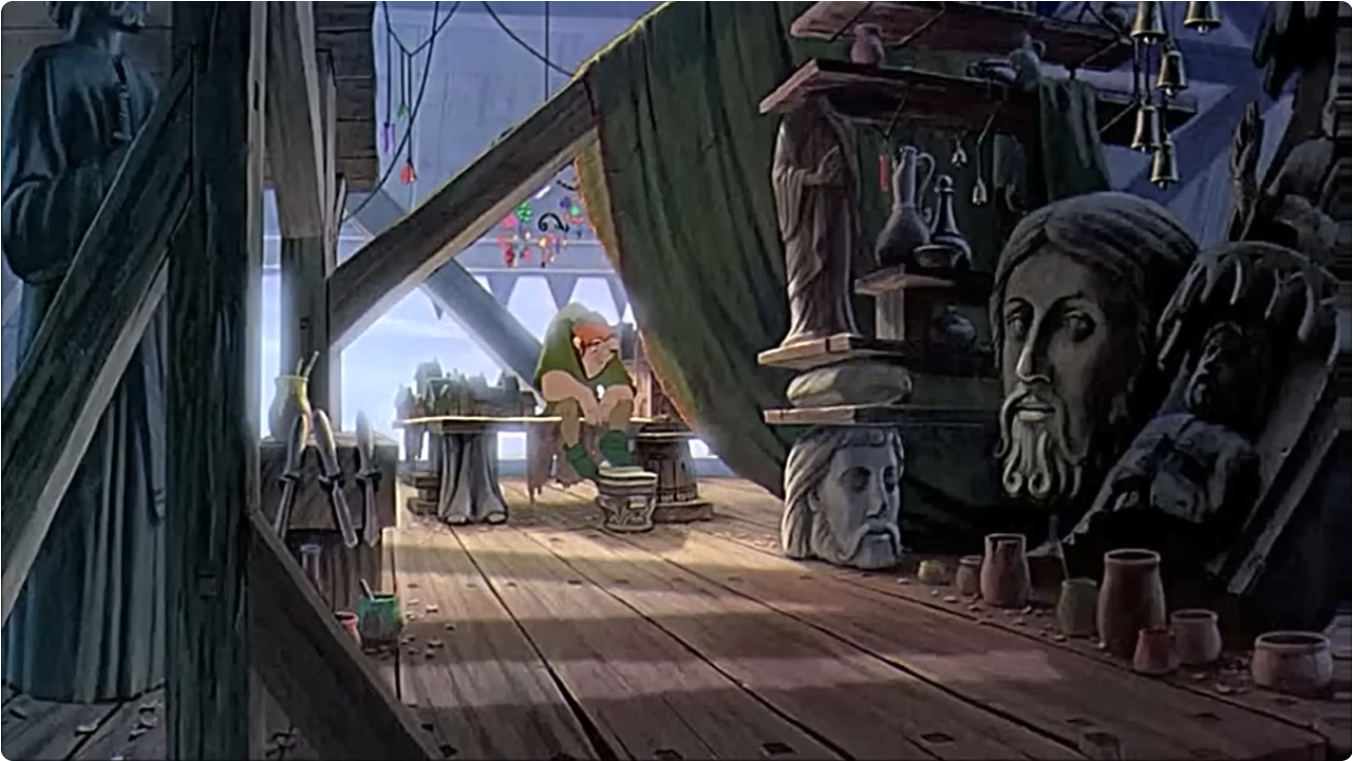
there is also a "note" of life Hunchback inhabits excellently - that of the vantagepoint from the cathedral rooftop or courtyard in a venerable city, with figures of laced black statue peopling the vicinity. I remember experiencing it playing some old Tomb Raider game where in one part you're in London, perhaps. Several footsteps, century by century, this figure or that rail or cornerstone - the civil engineering of Christendom. And rain, and glass, and pubsigns...
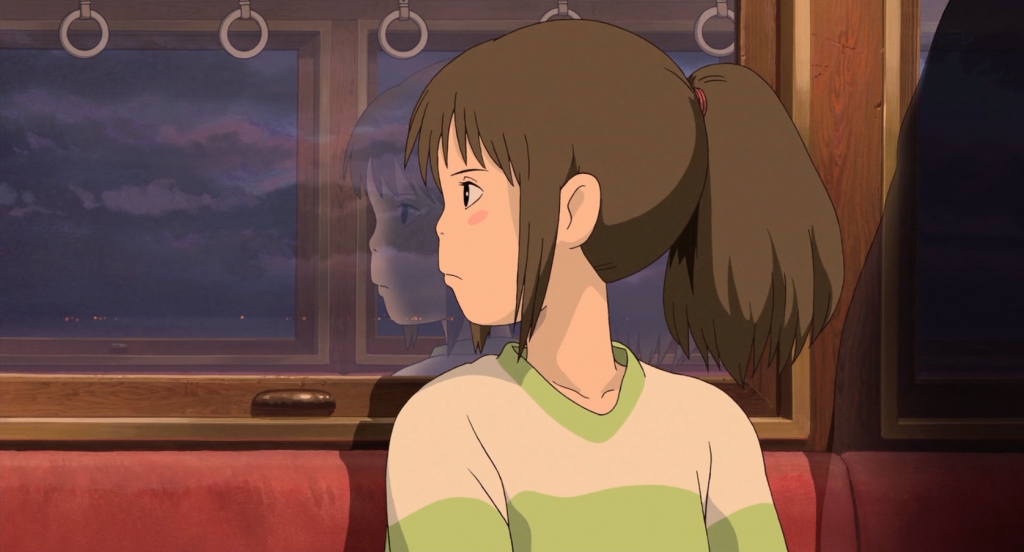
I will end by mentioning that in the last few days I have been being hurt when I think about Spirited Away. It is a lot. So little of it lived. When I had my memory jogged that in fact it came out in 2001, not a few years later, deepening the keystone, it hurt more.