
I had an idea for a series of three collage images - representing three stages of my life liking Lord of the Rings in different ways.
Lord of the Rings was the first thing I can ever remember being into. It was the #1 important thing as a child. I was into China and Japan too (much co-identified), but Lord of the Rings was the Juliet. I will talk about what each stage involved in the main body of this write-up. In middle school/high school, interest in it receded somewhat, not renouncing it but distracted - after all I was discovering other kinds of stories and worlds the world had to offer, and they seemed to be remote from the first thing, or even unintelligible to it. This will be a theme throughout this. Then in late high school I rediscovered Lord of the Rings. I was on online communities where western fantasy was talked about again - through tabletop games, Forgotten Realms, Warhammer 40k, /tg/ workshops, games like Skyrim, and Tolkien fantasy approached by Japan - various manga and games, and all-importantly, Berserk. Berserk was the sheer cold heavyweight to motivate my indolent 18-year-old heart to reaching - if not for Elbereth, for stars. At that time I pored over LotR and Silmarillion threads on /tv/ archives, searching various keywords from the Legendarium, in hopes of finding a new thread where Fingolfin, Ungoliant, Thingol, or Ar-Pharazon was mentioned. I loved the diffraction-spike beauty of cold stars over the field, as my own horizon seemed to be losing stars and light month by month. I spent year 20 in and out of hospitals; I lost 50 pounds and gained it back. Then it was time to breathe the free air and consider the green earth again, leaving the cold alien madness of the chicken's eye (a rather silly slander anyway) to its soothsaying, and to approach running streams. C.S. Lewis wrote a lot about the real good society - good Christian friendship - holding it up against the angler-lure of inner rings, of esoteric and elite cabals. It took an awful lot of violence and deprivation for my brain, after coming out of it, to finally begin to consider using its adult faculties to seek out the good society. Now that I write this, it occurs to me that up this present day, my attempts to seek out that society have remained incredibly sparse, perfunctory for the most part, uninhabited by devotion to the goal - dare I say lukewarm. Well, in any case, during that period then, I enagaged more with Christian spaces - Catholic twitter, Tea With Tolkien, American Solidarity Party, Sidewalk Advocates For Life, joined Christian discord servers, made Christian friends online, had an offline circle in the Sidewalk Advocates I did things with - much to recall for the very short fact that all this naturally brings one engage with Lord of the Rings again - but oh, it bears mentioning, it bears mentioning, it bears mentioning... And there comes the third stage. With the combination of a fully formed frontal lobe and a heart no longer reprobate, I could think about Lord of the Rings with some wing, some agility and fun and thought.
Now I have my three collages and a little science-fair blurb for each.

Lord of the Rings was the greatest inspiration of my childhood and inner life, and like many greatest things it somewhat stands in contrast and opposition to the other things. It's almost this thing like where a family patriarch's virtues and legacy are so great that it leaves the other members feeling a bit overshadowed and unsure what to make of themselves. There's a certain way that Lord of the Rings has a higher "rank" than any other work of fiction in my mind - parallel to how the worldbuilding of Middle Earth is both unrivalled in scale and inner integrity, I find LotR's theological vision to be one of one in the same way. I've never seen another story that puts so much eschatological weight behind its punches, behind its vision of itself. Both the Legendarium and, in summit and microcosm, the book Lord of the Rings. Naturally I'm biased as a fellow Catholic to agree with Tolkien's vision as "True", but I'll put it this way: I could very nearly believe that if the tale's conceit was real, that this was a real life story preserved through the Red Book to the present day, that it could actually have happened the way it says it happened and be recorded the way it was recorded. For a story with a scope as large as Creation, involving an account of Creation and consciousness of salvation history, to feel like it like it could actually be a real part of it, is astounding.
Reality has a kind of pitch to it. Even if unsure what the real Truth is, a person keeps finding this notion of the Truth suggested to them - by understatement, by alleged breathless witness, by cataclysm, or by some movement too central and private to dare suggest it exists to the external world - kaleidoscopic or misleading, the hints keep being dropped, and they are bread and nothing else. A character in a story may not see where is the pen, and its strokes feel abrupt, confusing, violent. The chapter of the soul's life may appear to be a painful and ugly one. Yet in that chapter is contained every story, every song, every caught breath, every soft remembered thing. They are dyed in the tempest beating around oblivion and come out solid and whole.
Not that LotR feels perfectly real - but it's the only fiction I know that tries its hand at cosmological history, and ends up feeling somewhat real. A lot of good stories have cosmological scope and feel metaphorically real, or like they're successfully stylizing reality - but LotR is the only one that feels like a genuine artifice.
And - my frustration - despite its ecstatic sunscrape with Reality, it isn't transplantable. It needs England. It is an English tree. Much is in the English soil - the North, Rome, antiquity and Atlantis, Christendom - but it all grows out of England. What I'm talking about isn't wanting to change Lord of the Rings - I don't - but wanting to get its quality into something else. Not everything can be English, can be Sarehole. And that's fine, that's good, God made the world bigger than Sarehole. But I want to take the substrate of Inspiration Tolkien found in Sarehole and spread it. I don't want Lord of the Rings to stand tall and alone. At least as far as my own inner world's feng shui is concerned.
But anyway, as a child, I full-heartedly avowed myself to sword-society, against modernity. To all forests, against all cities. Which was silly, because I loved being in cities when I actually went to one. Not everything I liked was LotR-affiliated. Some was - ravishingly, like Baldur's Gate on the family PC, whose main menu I swore I could smell. Some not - like my nascent world of anime, video games, and internet. But those, thinking about it now, were bound up with LotR in a way - my older sister liked all of them. Before I had anything to care about with culture or anthropology or sin, there was the unwavering, beaconlike optimism of following in her footsteps - assured that she was on the trail of heaven. And we were - but the heaven grew forgetful of itself and splintered like the congregation of Babel.
Jackson's LotR films were my center of a general scape of Western fantasy, but there was a certain tone to the Jackson movies that marked them out different. It's a sword-world of medieval or antiquity, but there is Bilbo in Bag End on the night of his departure, this gold-yellow ring and bright midnight-blue treeline. There is Ian Holm in the DVD appendices speaking to the camera, candles soft in the digital glow, the cloudy forms of blue trees rustling behind black latticework. Behind the Elvish world of the Jackson films is another close parallel one, the human world of the filming in New Zealand. It was probably good for my soul to see so much of it, boom mics and windblown parkas and trailers and locations from Middle-earth awash in digital artifact, alongside the Elvish finished product. And it gave some kind of indelible primacy in my mind to - not England proper - but the outer countries in its sphere as seen at the turn of the millennium, raincoats in New Zealand mess halls or atop brown hills, spied through fisheye lenses, or accounts of bedraggled men swinging swords or headbutting each other outside of pubs in cities like "Christchurch" or "Wellington", and the constant unsanctioned refrain to the kingdom of rainy green ruined abbeys. Thanks to the Appendices, and the Celtic beauty Tolkien's Catholic elvish heart relucantly danced cheek to cheek with, Zombie by The Cranberries probably has some unremittable parcel of real estate in my soul that could be activated like a sleeper cell should we ever go to war with them. I wouldn't turncoat, but I would halt perplexed for a brief moment before getting my skull crushed by a furious buckle-shoed man's great verdant mallet.
I often wonder at how the film team somehow made a kingdom. Pippin casts his brooch on the grass bottom of the ravine - somehow, Aragorn picks up and turns over a kingdom in his fingers. It has that open-skied spiritual spaciousness real kingdoms have - the scribe of Tours' bells or Bede's shores. How, how did they do it? It's humbling. Looking at John Howe's and Alan Lee's art, I can certainly see that was a core ingredient, but my imagination could never have built up, from that, the leaf in the ravine, or the torchlit patter of rainy metal in Helm's deep.
The end of The Two Towers, where Frodo and Sam follow Gollum through Ithilien covered in dry pine, and it pans up, up the mountain wall to Barad-dûr and Mount Doom and side by side, ringwraiths twinkling in the lightning, rushes eternally to my side and becomes one of the cursed items that claim a place in your inventory and can't be unequipped - an indignant ferocious guardian, diving down with claws out and snatching up each forgetful mute that did not answer the call, holding it exposed up in the ozone, the Manwë-thought, shrouding it in knighthood and rose-spells.
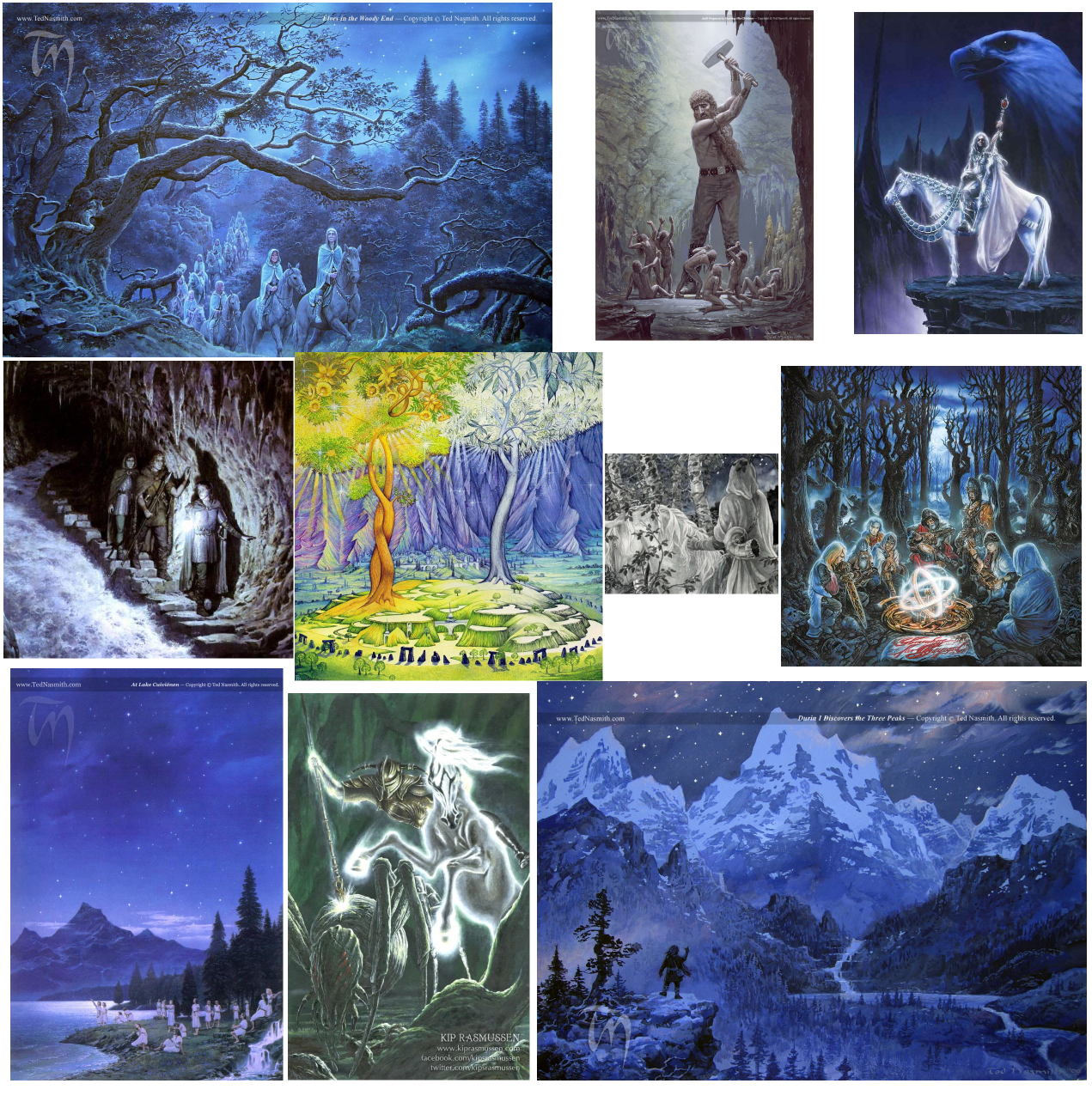
In the second stage in late teens, I became excited realizing that there was a theatrical aspect to the Legendarium. In the manga Act-Age, there's a painter who paints ferocious Japanese deities, demons, with smoking nostrils and karmic wheel halos. To vent her emotions, or unsuccessfully try to. Later is a flashback to her childhood in probably Aomori, how she used to actually see a snow spirit outside the house when it snowed. I can't find the chapter but it was a small elf-like humanoid floating around using a leaf it held as a sail. And how she can't see it anymore. In both cases, the snow fairy and the angry oni, it's concerned with a deep part of the personality and experience of a character. The painter is also a playwright; writing a play with some other classic Chinese mythological characters, Princess Iron Fan and the Monkey King... very very stylized characters, and in very intimate contact with the real life human characters in the story. So you have this personal realism, these high-fidelity depictions of the inner life of these human characters, on one hand, and on the other hand you have these very stylized, ornate and bright-metallic-hued figures of divnity. Though on the other hand the snow spirit, whose name I cannot find online, exists in a gentle and unassuming way, the same mark of invitation to theological reality that Tolkien's faerie has.
So I became very interested in this concept of reality interfacing with stylized myth through art. The Silmarillion had this draw for me; I imagined directing an adaptation of it that had both the sort of fidelity to reality I've also talked about in the first section, and also had the stylized drama of the theater stage and mythology, and somehow marry the two. Lord of the Rings, the novel, is irreversibly enfleshed by the Jackson films - everyone in the story has been incarnated as real guys. Not just a Cold War artist's personal stylized interpretation of another artist (Tolkien)'s private mythos, or an awkwardly cast Eastern European actor from an 80s adaptation, or a rotoscoped so on and so forth - all worthy things in their own right, but odd and skew enough to be superceded by the world of the Jackson trilogy. I don't mean to claim that Jackson's depictions are the definitive ones, or worth more than previous ones, just that they're sensible in a way where you can't go back to a character in LotR being "unseen", abstract or locked behind a silhouette. That's regarding the characters, of course the physical realm of Middle-earth is even more definitely "uncovered" by the films than the characters are. I've seen plenty of complaints about the casting of the characters, never any complaint about the casting of the Misty Mountains.
But the Silmarillion is a different thing. Related but different. Beleriand is darker and brighter and younger and colder. The characters are... well, taller. And greater. Practically speaking, I don't know that there is a group of a dozen humans currently alive with the ability to depict the main cast of the First Age without shrinking them, physically and non-physically, in the process.
So here's the thing... people talk a lot about how the Jackson trilogy supplanted previous differing artistic interpretations of Middle-earth, Ted Naismith for example. I think it would be more important not do that for a Silmarillion adpatation than for a LotR adaptation. Because as Tolkien himself said, he built his mythology dreaming of it being a shared mythology of England, where others could join in, "wielding paint and music and drama." So I think it's fitting for an adaptation of The Silmarillion to draw from those artists who were inspired by it, because the collaborative process is thematically fitting for what kind of creation it is. How much did a thing like Blind Guardian do to make the Legendarium more vividly alive to the world? A whole lot. I don't know how to execute it but I would want my adaptation of The Silmarillion to somehow have Blind Guardian's gift inside it. There's not a version of Fingolfin's fight with Morgoth for me that doesn't contain the drama as expressed in Time Stands Still (At The Iron Hill). Or even more, the flight of the Noldor without Into The Storm. There could be, but it'd be like painting the sky without blue paint. The hue must end up somewhere. At that time I browsed a lot of generals on /tg/, /tv/, /k/. Collaborative workshops, themed threads, threads for franchises I didn't exactly "get", didn't quite know the intended primary medium of engagement. It was kind of like wandering through labyrinthine dwarven halls, lots of fires and voices and clattering sounds and purposes somewhat obscure. I had begun to enjoy different perspectives - people engaging with the same object of interest and failing to apply my worldview to it, sometimes tantalizingly half-agreeing, sometimes administering irreverance or perversion to what I had understood to merit religious devotion. In my childhood such things disturbed me deeply, in adolescence I preferred it. In my adolescence, too, I grew out of my fear of the dark, by starting to go on walks at night, discovering joy and peace under the stars.
But did you love the name of God? But did you love the name of God? But did you love the name of God? But did you love the name of God?
But did you love the name of God? But did you love the name of God? But did you love the name of God? But did you love the name of God?
But did you love the name of God? But did you love the name of God? But did you love the name of God? But did you love the name of God?
But did you love the name of God? But did you love the name of God? But did you love the name of God? But did you love the name of God?
I said I would talk about Berserk... I don't know. There's Guts lying in the grass, it's raining on his face or he just killed some wolves and it's cold. To quote Tolkien,
Much though I love and admire little lanes and hedges and rustling trees and the soft rolling contours of a rich champain, the thing that stirs me most and comes nearest to heart's satisfaction for me is space, and I would be willing to barter barrenness for it; indeed I think I like barrenness itself, whenever I have seen it. My heart still lingers among the high stony wastes among the morains and mountain-wreckage, silent in spite of the sound of thin chill water. Intellectually and aesthetically, of course; man cannot live on stone and sand, but I at any rate cannot live on bread alone; and if there was not bare rock and pathless sand and the unharvested sea, I should grow to hate all green things as a fungoid growth.
This was my large discovery at this time in my life. There it is - Simon Swerver, Danger Room. You ever hear something while seeing something and the combination just triangulates into a brand new feeling? In 2015, that song and a certain Berserk panel of a character named Sonia peering out with an unbothered optimistic smile from beneath her duckbill-shaped visor - maybe it was the shape of the visor that did it. The path of her eyes having to travel a distance outward to get out from under the duckbill, that distance, probably had an effect of situating me, the viewer, in her position, so that the heat of bonfires and flicker of torches reflected in the bill's metal underside and smell of beer and mutton came beaming forth out the page. At that time, I was obsessed with creating made up alphabets and syllabaries, endlessly refining the aesthetic concomitance of charts of glyphs, trying to get it to somehow have the flow of lowercase and the gravity of uppercase at the same time. I filled hundreds of pages of printer paper with scrawls of bright blue ink, and fantasized about setting up a circle of fans around a pile of these papers and doing a kind of ghost dance in the tornado of them dressed in a cardboard bird costume. At that time, things like that were the most constructive thing I could think of doing. I didn't do them. I don't think this is relevant.
There are two things that pertain to the topic at hand. The dramatic elements of the First Age, and the feeling of being in a cold field. Blood coaxed across the reeds by a cold gust, how would you depict a Silmaril on a screen? The anemic desire for windswept pagan christening, the blessed awakening of Durin. The stars wheeling overhead, the stars held still in Mirrormere. These things are available for public consideration. Important, to end, to not judge my old regrettable state together with the exalted space that consoled it. I still leave it in large unsaid, the divinity in the airbrushed thunder, clapping out from the Meat Loaf concert poster in Bergen in 2008, upon the Cuiviénen of my soul, and it leave it unsaid, the thunderclap discovery of romance in the coeval world, the shock of Alice's silhouette, the pumpkin carriage and Pied Piper's mice in procession, and the peel of film-blue sky, over sand and tent and mountain, carabiner-clipping scene by scene until the decade is touching your skin.
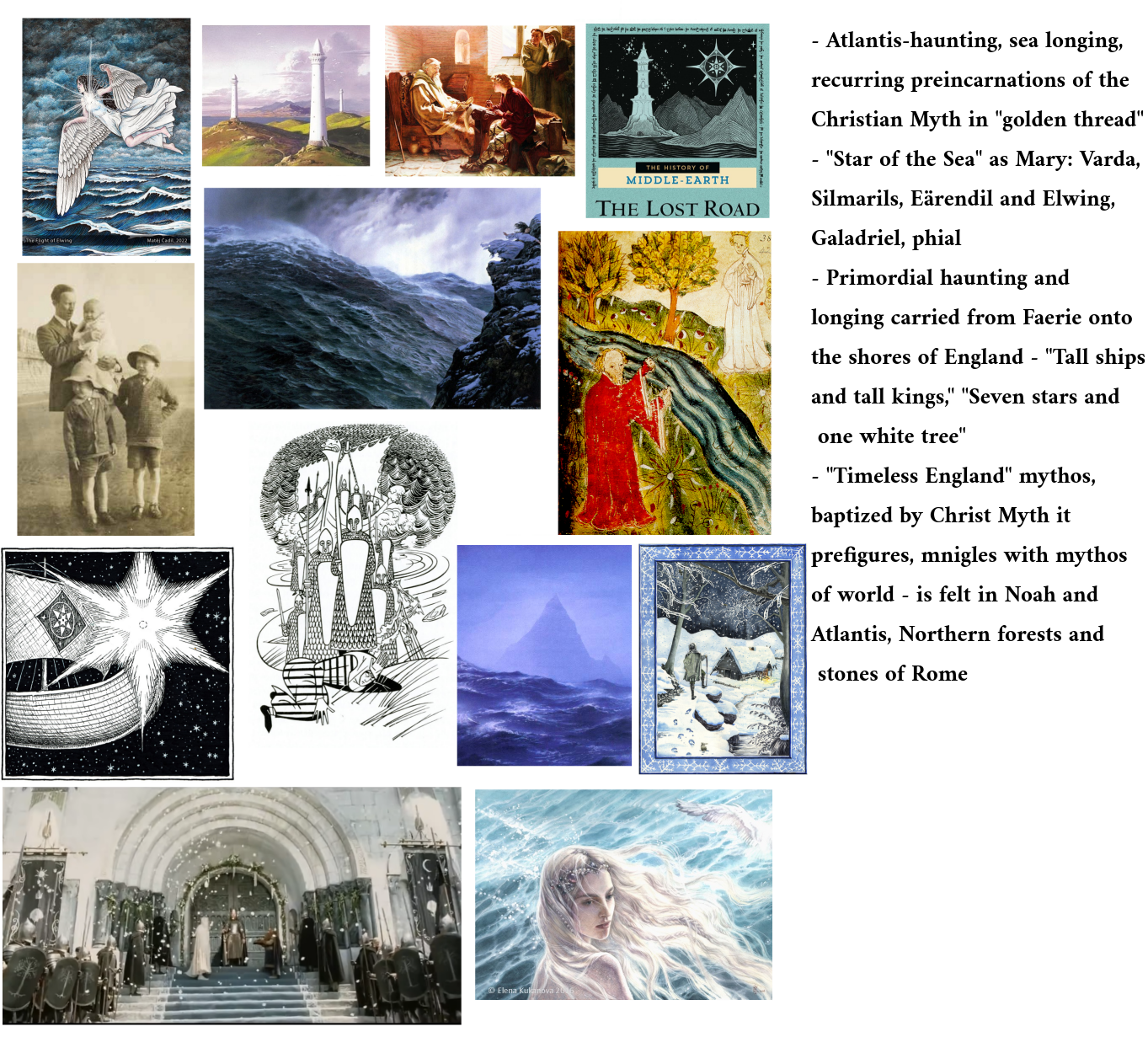
Now, this one surely is too tall to write tonight. I actually had a much much briefer blurb for this one already made, so maybe I'll just include that. There are two things in particular I want to mention. I've never written a fanfic, but if I did I think I'd like to write one about the Wardens of Westmarch, the descendants of Elanor, the Fairbarns, in their dwelling of Undertowers in Emyn Beraid, the Tower Hills. The current age experiences the Tale through the Red Book of Westmarch, handed down to Aelfwine and discovered by Tolkien. A certain thing, the thing Feanor saw refulgent in Galadriel's hair and which he imprisoned in the Silmarils, the same certain thing which Elwing carried to Earendil through the tempest, and which burst forth in Sam's hand on the steps of Cirith Ungol. The exiled faithful brought symbols and shadows of it to the shores of Middle-earth. It was announced by Arwen's banner on March 15, and on March 25 it was claimed for His own. Celebrated and sensible in Cormallen, and at Aragorn and Arwen's wedding, and its light no doubt lay in a well behind Eldarion's eyes. That is its final appearance in the Red Book of Westmarch, and from there on there is just the rest, Aeneas and Christ and Bede and the close-borne shoulders of Oxford's hallways, peering down on the curious Red Book. The Tower Hills is where there is contact with both. I want to write all about that.
The second thing is that I really like the picture in the bottom right by Elena Kukanova. It's Eärwen, Galadriel's mother back in Valinor. It makes me imagine a narrative aspect where the sea-longing of Legolas, Frodo, and Tolkien, carries one over time, as Gandalf described to Pippin aboard Shadowfax, back in time over the sea, to the shores of Valinor. The white tree of Gondor in flower over the King's wedding, back to its parent Nimloth the Fair, brought to Middle-earth through the drowning storm, back over the sea to unswallowed Numenor, back to Beleriand and the back through the tempest of waves and fire on Elwing's breast - perhaps in her and Eärendil's perilous odyssey over the sea to Valinor, at some particularly grave moment, it was Eärwen, mother of Galadriel of the silver-gold hair and sea-elf, who turned back to look east across the water, and it was her prayer who breathed flight in Elwing's feathers and carried them to shore.